
What is EMDR Like?
Trauma therapy in person in Wichita and online across Kansas
What’s EMDR?
You might have heard of EMDR on social media: Eye Movement Desensitization and Reprocessing is gaining more widespread awareness, but what is it? If it sounds mysterious and you feel some skepticism or wonder if it is a little too “woo woo,” you're not the first person to feel some healthy skepticism (and if you're still mixing up the letters in the acronym, that's also common!).
First of all, EMDR has many stages, so you will be “doing EMDR” long before you do the bilateral movements it is most known for. You won't (or shouldn't!) be asked to start moving your eyes while talking about the hardest moment of your life, on day one. EMDR begins with preliminary work around making sure you're internally prepared for the trauma work, and that could take a few weeks or many months, depending where you're at right now. All of the preliminary work is valuable and helps you toward healing, so don’t be discouraged if you aren’t jumping into eye movements as fast as you hoped. Typically at least the first few sessions of EMDR will involve running assessments and practicing skills to make sure you feel prepared. We aren't going to jump in the deep end and open up things you're not ready for, because your wellness is the ultimate goal - crashing you is not the goal.
Once we arrive at the point of bilateral movement, we'll step into that brain+body work by exploring how trauma-related beliefs, physical sensations and emotions, are intersecting for you. After selecting a focus, we'll figure out the mechanics: Do you like eye movements, or would you rather use the tappers in your hands, or do you want to tap your own arms in a butterfly hug? Even though it is called Eye Movement Desensitization and Reprocessing, eye movements aren't the only way to engage the brain in side to side (bilateral) movement. Most people develop a clear preference of which option is most comfortable for them. A lot of people like the handheld pulsers (see picture below) because it allows them to close their eyes while processing, or because they need to add additional forms of bilateral movement to help them focus.
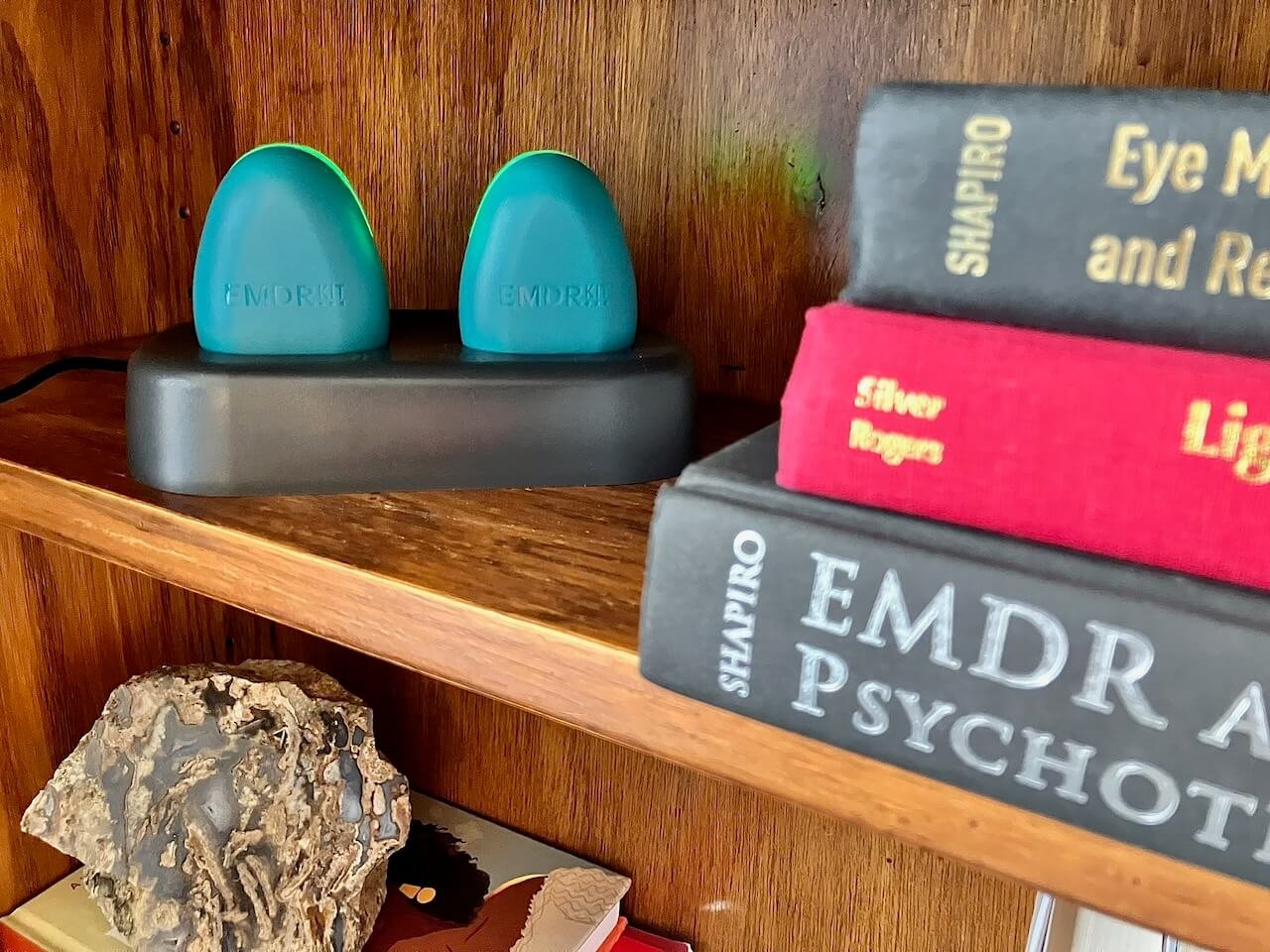
EMDR hand tappers charged and ready to go!
Then you will hold the selected intersection of belief+sensation+emotion in mind while also paying attention to the bilateral stimulation for a series of movements. We'll pause at intervals, and I will briefly ask what you're noticing. Most often I'll direct you to “just notice that” in response and we'll go right back into bilateral movements. The power is not in you telling me what you're noticing; I am only collecting enough information to direct the next segment. It is even possible to process a memory without telling me much about it! I am willing to bear witness to your memories with you, but equally: I don't have to know the details to support your brain toward resolution.
What is EMDR Like?
Sometimes I describe EMDR as exploring a dark cave. You’re safe with a guide and not on your own, but we also don't quite know which nooks and crannies lead somewhere and which will be dead ends until we go look at them. So we will start in one place, feel our way forward around the edge of the cave, and delve into the rabbit trails of the memory as your brain brings things up. Occasionally I'll redirect, but mostly we'll follow what pops up for your brain as you hold that traumatic memory.

At the entrance of a cave
We prioritize following your brain rather than leading it from the outside for several reasons:
During EMDR you are not in a trance, you're not hypnotized, and you're not out of control. Your brain is fully present as an active participant in healing.
Furthermore, your brain wants to heal; with support and some guidance, it will find the way faster than an outsider's guesswork can take you there. Often the client's brain starts connecting dots during an EMDR session that I was not yet even aware existed because the client hadn't realized yet either – healing happens deeper, wider, and faster than I could guess the way forward as an outsider to your brain.
I'm not worried about whether your brain is focused on the “right” thing, for the most part. Trauma is not always stored in your brain in ways that initially make sense – a sensation might be the key to unlocking things, or a minor memory of something not significantly traumatic might generate transformation. Because the brain has a fabulous instinct toward healing itself, we can generally follow its lead.
During a session with bilateral movements, it is not uncommon for your distress to initially increase. But as we keep moving forward, things start shifting: emotions calm, body sensations decrease, new insights emerge, or mental images change focus. The memory itself doesn't go away with EMDR, but processing takes the sting and distress out of the trauma memory.
Occasionally an EMDR session gets stuck – and that's okay because the work of therapy is exquisitely human with ups and downs. If you have a dud-feeling session we'll revisit it next time with curiosity – and sometimes, what seemed like a dud session does end up producing new realizations before the next appointment. On the other end of the spectrum, sometimes a dramatic leap forward does happens in a single session – particularly when we're just working on a single incident trauma! But most sessions for most clients with complicated trauma histories, EMDR functions as a steady chipping away, week after week, peeling away layers of the onion as we get down to the bottom and build something new together.
In an ideal world, EMDR sessions would be long enough to follow all the way through to the resolution of a memory before the end of session, but in the real world of insurance requirements around appointment lengths and particularly with more complicated trauma histories, processing a memory can stretch across multiple appointments. (If you are a cash pay client, longer appointment times can be scheduled for EMDR, that insurance companies don't enable.) But that doesn't mean you are sent back into the world with all that distress at a peak: the last portion of a typical insurance-based appointment is always saved to bring you back down into normal life and to tuck the trauma safely away until it can be picked up again at the next appointment. Incremental progress is still progress.
After an appointment involving bilateral trauma processing, you may notice a sense of bodily exhaustion in response to the work accomplished. When possible, try not to schedule a heavy day after your EMDR session but allow yourself space to hydrate, rest, and finish absorbing the changes. You might notice new insights and further shifting in the memory between appointments – because your brain wants to heal. And that's what EMDR is all about: facilitating the healing your brain and body are ready to do!
EMDR Therapy in Wichita, KS
If you're interested in discussing whether EMDR might be a helpful treatment for your trauma, reach out to schedule your free consultation. You can read more about me here and about how I treat trauma here. I see clients in person in Wichita and online across Kansas, and I offer free consultations to all new clients because I believe you deserve to enter therapy confident that you’re in the right place for the work you want to do!
Elizabeth Peters, LMSW is a licensed therapist seeing clients in person in Wichita and online across Kansas. She provides EMDR and somatic therapy for adults who are overwhelmed by anxiety, painful relationships, spiritual harm, and trauma.